Your next win is buried in the stack. Invitations from BuildingConnected Bid Board Pro and plain email land in one place, scored on GC quality, fit, distance and documents. The winnable work rises to the top. Your estimators still make the call.
No team can read all of it. So the pile gets worked from the top down, which has nothing to do with which job you would pick if you had read it all.

Bid Board Pro, GC portals and plain email, each on its own schedule. Nothing about the order they arrive in tells you which ones fit your shop.
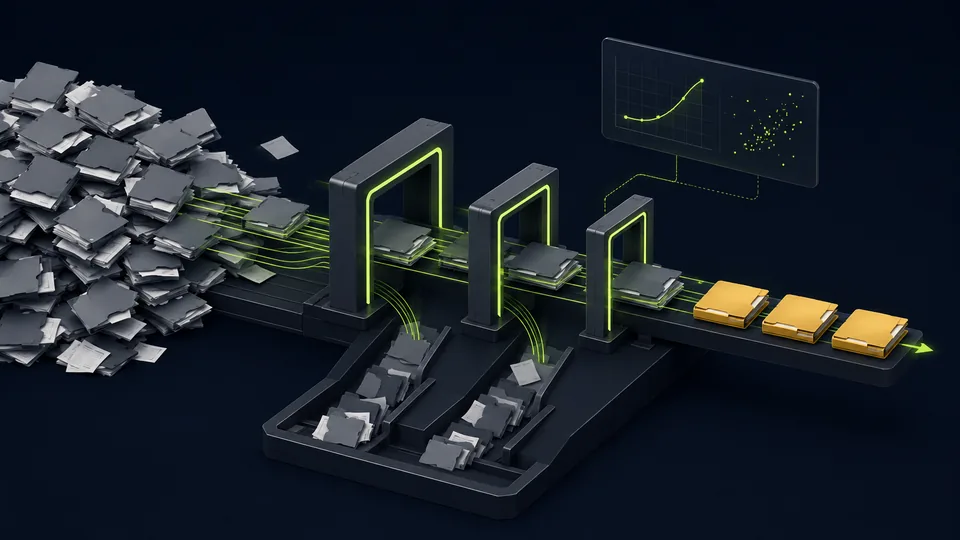
Scored on GC quality, scope fit, distance, how complete the drawing set is, and how much relationship capital you already have with that GC. The marginal work steps aside instead of eating your bench.

Your estimators open the best-fit job first, with the reasoning already attached and the rest still there when they want it. They still make the call. They just stop making it blind.
Same bench. Same hours. Pointed at the work you can actually win.
Book a consultWe will probably never cancel Bid Board Pro or let it lapse.
 Kennan Westbrook
Co-owner, Texas Welding Company, with Erin Westbrook
5-year Bid Board Pro subscriber
Kennan Westbrook
Co-owner, Texas Welding Company, with Erin Westbrook
5-year Bid Board Pro subscriber
BidStrike is built on BuildingConnected, syncing through Autodesk's sanctioned API. Your invitations arrive exactly the way they do today. Not a rip and replace.
This is the real sequence a specialty contractor runs on every job. Nothing in it gets removed, and nobody's seat gets automated. The bottleneck has always been the go/no-go at the front of it.
This history is not an archive. Your own record is what the score reads first: jobs like this one that you have already priced, how you have done with that GC and in that trade, and where your number sat against the ones that won. It reaches your estimators as a range on the estimate, so the person about to submit is weighing their own margin and their own risk against how that price has actually performed for you.
Who you know at that GC is not a tiebreaker at the end. It is weighted into the go/no-go at the front, and it stays attached through the bid, the follow-up and the award. Teams bid where they have relationship capital, instead of bidding whatever sits on top of the stack because it resembles a job they have seen before.
Bidding state, local, education and utility jobs straight to the agency is mostly a prime and CM-at-risk question. That lane is SLED Radar, a separate product. BidStrike scores the private commercial work you get invited to. If public work only ever reaches you as an invitation from a prime, you already have it, and nothing over there changes your week.
Every invitation that reaches your Bid Board Pro inbox gets read and scored overnight against your own gates and your own go/no-go questions. Your bench opens the morning on work that is already in order, with the reasoning sitting next to it, and spends the day on clients instead of documents.
Your gates, your no-go list, your radius. Your people still make every call.
Software does not make anyone pick up the phone. It just stops burying the people whose whole job is the phone. Your preconstruction and business development bench carries that work, and they are the ones the triage costs the most. So the platform takes the sorting, and Strike School runs as two separate trainings, because precon and estimating have never had the same problem.
Their hours belong on client-facing work no machine can do, because it is inherently relational. Overnight, every invitation that reached your Bid Board Pro inbox is read and scored against your own gates and your own go/no-go questions, so the morning opens on a ranked stack instead of a pile.
What that hands the bench is the part they could never get to: which of the contractors sending you work you already hold real relationship capital with, and where there is live work worth pulling into the boat alongside the accounts you are already close to. Strike School teaches them to turn that into booked conversations and booked work. Your people still make every call on what to chase.
The hours come back, and the scope conversation is what they come back for. Estimator to estimator with the GC during final scope review and revisions, with the people who buy out their number and send the award.
Sandra Business development coordinator New-hire onboarding sessionI've learned that even if they lost the bid, they're still willing to discuss those numbers with me. That's when I found out we were turnkey, and they're willing to pay more for that fact.

Nobody takes a trophy watching every deer in the woods. You win by being ready, with a clear line, the one time the right one steps out.
That is the whole job of the go/no-go. Fewer things between your team and the shot that actually matters.
Syncs with the tools you already run
Sorting out how these platforms divide up the bid? Read the plain-English breakdown.
If it has an API key, BidStrike syncs with it: CRMs, PM platforms, and the tools your team already runs on.
ConstructConnect is planned, not live. It is the closest parallel to Bid Board Pro and it is on the roadmap. No customer is running on it yet, and we will say so plainly until one is.
Open a scored invitation, set your number, hit submit. BidStrike pushes it everywhere for you.
Strong fit: recommend bid. Reputable GC, scope matches your shop, and the drawing set is complete. Estimator's brief is ready, with the pages that matter flagged per scope item.

BidStrike is built by Rodney Smith and a small team of consultants and developers at Smith Revenue Strategy, on one idea: software should hand the hours back to the people who already know your work. It is not built to replace anybody. It is built so the estimators and precon people you already employ can spend their time on the part a machine will never do, which is sitting across from another person and earning the next job.
Read the storyTwenty minutes. Bring the stack nobody gets to the bottom of.
Your precon bench stops sifting and starts calling. Your estimators start on the ones that matter.
I'm Rodney. I built BidStrike, and I'm the one who answers. Pick whichever way suits you.
Book a consultPick a time on my calendar. We'll run it against the kind of work you actually bid.
PS. Estimating capacity stuck on go/no-go is revenue you never bid. If that's you, book a call and we'll look at what a tailored fix frees up.
